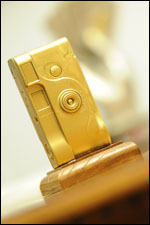
It was an honor to speak at the 2nd Annual @PhotoGuild Dinner earlier tonight on the topic of “Is Your Photography Art?” My sincere “Thank you” goes out to the membership for the Golden Camera Award – it is a real camera! – now sitting at the forefront of a growing collection of special memories.
Here is a very brief outline of the 20-minute speech prompted by and based upon materials from the Vermont College of Fine Arts @VCFA recommended reading list, including “But Is It Art?” edited by Nina Felshin and “Photography” edited by Liz Wells.
Photography’s acceptance as a viable and legitimate element of the art community is recent and has at its roots the political and social activism of the 1960s. By the 1970s, the visual artist adopted photography as an additional tool for the establishment and distribution of the artist’s message.
Consider these questions: Is your photography art? If a photograph gets a reaction does that make it art? Otherwise, is it just a pretty picture without artistic merit?
Legendary photojournalist W. Eugene Smith said in an interview with the New York Times in the 1950s, “I don’t think that a picture just for the sake of a picture is justified.”
The documentation of history has changed since the chemical-based photography of Smith’s 1950s. The increasing popularity of still photography and video in digital format has made it possible for nearly everyone to become a citizen journalist. But, is the resulting imagery just a collection of pictures or is any of it Art?
Moreover, have staged events and photo ops been used as performance art to subvert true visual arts activism in the modern political and social arenas?
Finally, has the history of film photography affected our perception of a color image as more artsy and black-and-white as more historically accurate?
Now, given these conditions and considerations, you must ask yourself: Is your photography art?
Thank you to the Artist Guild of Spartanburg for asking me to conduct a program earlier this evening on the topic of The Basics of Social Media for Artists. The packed room was full of great questions regarding the role of social media in the promotion of an artist.
Key points of the presentation included:
– how to use social media to attract a quality audience
– information regarding copyright and image licensing
– blog content and linking directing an audience toward their web presence
Social media is a huge topic to cover in the allotted 90 minutes, but most left with a better understanding of the differences in the various social media platforms. The audience was also reminded of the importance of peer support in social media. Collecting quality followers is a matter of networking – locally, nationally, and globally.
My social media mentors for the past year – Leah Vaughn @shoeracing, Aubrey Hudson @LVMotorSpeedway, Lynn Appleget @ApplegetAssoc, and Roger Bear of @WSSU – all received a credit in the presentation. The MFA in Visual Arts program at @VCFA also got a hit in front of this group of Upstate artists. Even Think Tank @ThinkTankPhoto and Camera Bits @PhotoMechanic got a quick plug with photographers in attendance.
Social media for photographers and artists is just one of the lecture programs on my schedule for 2013. If your public or private group or club would benefit from an informative and entertaining presentation on social media, copyright and licensing, or professional photography use the contact link to request more information.
Most of my professional career has been spent creating candid portraits of sports figures, politicians, models, and private clients. My favorite tool is existing light. So when I saw this scene reflecting in a window as I worked over a light box reviewing my slide archives, it was something that I had to capture. This photograph now serves as my introductory photograph on my web site www.davidallio.com.
For the past several years, I have been working to get my racing photo archives scanned from silver-based film to a digital format. This has required endless hours of sorting negatives and slides at a light box. Fortunately, the negatives have been filed by track and date, and most of the Kodachrome and Fujichrome slides have been labeled. But in the haste of the moment, some slides – now 20, 30, or more years old – were not cataloged when they were processed. So now, I am spending time at the light box sorting and filing in preparation for digital scanning and captioning.
In the days before digital photography, chromes were the best way to have a color photograph published. Now, in order to continue to share those images, they must be scanned into a digital format and captions embedded into the digital files.
Today, www.racingphotoarchives.com is one year old. In that leap year, 366 original motorsports photographs have been presented in the daily blog. Looking ahead, 365 will be required for a daily presentation this coming year. In total, my photography archives contain over 300,000 photographs – digital and film – spanning over four decades of various forms of motorsports.
Anyway, as I was saying, this scene – originally seen reflected in a window – seems to capture me in this moment of my life. In many ways it is an old school moment because of the stacks of film slides and light box that represent a previous era in photography. However, it is also representative of me, now, as I work to bring history into a more modern format. That should be the goal of any portrait – to tell a story of a moment in time.
The lighting is not flattering. I look old, much older than the teenager I was when I began my career in motorsports. But, I have earned every age line in my face – frame by frame and lap by lap.
Camera: Nikon D3 | Lens: Nikkor AF Zoom 24-70mm f/2.8G | Focal Length: 36mm | Exposure: f/8 – 1/6th of a second – ISO 1000
 Consider these questions: Is your photography art? If a photograph gets a reaction does that make it art? Otherwise, is it just a pretty picture without artistic merit?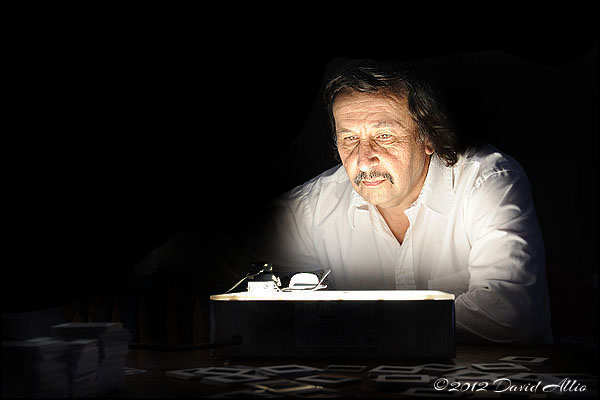


You must be logged in to post a comment.