Since Thanksgiving, it seems that my e-mail in-box and social media accounts are overflowing with offers relating to photography contests. Most often prizes of cash and/or merchandise are promised to the winners of these contests.
Rarely do I enter photography contests and here is an example of why I choose not to participate. A recent photography contest co-sponsored by two of my favorite corporate brands came with the following statement in the rules: "By entering, Entrant grants all Sponsors an irrevocable, perpetual, royalty-free, freely transferable license to use the photo for all purposes, in any and all media, whether now known or hereafter devised."
Let’s look at that one sentence for a few moments. The word "irrevocable" means that you cannot change your mind following the submission. Once the photograph has been given away, it is gone. That is followed by "perpetual," meaning forever. Then comes the part where they do not have to pay for the use of your photograph – "royalty-free" – winner or not. Next are the terms indicating that they may give it away to others for any reason, again without paying: "freely transferable license to use the photo for all purposes."
These terms are unscrupulous and entering a contest or posting to a social media site with these terms is unconscionable, not just to the photographer responsible for a contest entry or post, but to any competent photographer. This is how to lose at a photography contest. The submitting photographer loses control of their photograph, and at the same time, the contest sponsor gets thousands and thousands of dollars’ worth of free images for their unlimited use. Think about it: Do these companies give away thousands of dollars of their product and not expect something in return? So, why should they be involved in the promotion of a contest with rules demanding exactly that?
These are not the only two companies to include this or similar language in their photo contest rules. Many businesses, including some very popular social media sites, go even further and indicate that a submission or posting gives them the right to re-sell an image without compensation to the original photographer. Some now even go so far as to require that the photographer give up any claim to copyright. So – win or lose – a photographer loses control of their creation, forever.
It is one thing for a sponsor to request a reasonable license and time frame for the use of a winning photograph. But for an entity to control reproduction rights, forever, of something that they did not create or for which appropriate payment has not been made amounts to theft. Oh, it is legal to write these terms into contest rules. But it is an ethically questionable tactic for obtaining photography for marketing and content at less than fair value.
The photograph shown above may never be a contest winner, but it is similar to an image that has been repeatedly licensed and published in calendars and on post cards. This photograph is similar because if the exact same image were to be published here it would probably be a violation of my contract or licensing agreement with the publishers. However, each time the original photograph has been published and re-published, I have received a payment for that reproduction. Every time an amateur agrees to provide an image without appropriate compensation, they are corrupting the overall creative and commercial value of photography, not just for themselves but for the overall industry.
Warning: Read the rules carefully before posting to a social media site or entering a photography contest. Know the terms before submission. If you still decide to enter a contest, good luck!
If you would like to learn more about copyright and image licensing, contact us about an upcoming Experience Photography workshop.
Emotions are running high today. The tragic and unreasonable deaths of 20 children and six adults at Sandy Hook Elementary School in Newtown, Connecticut, are enough to put everyone’s nerves on edge. Only the Virginia Tech Massacre ranks worse at this point in the history of school violence.
At moments of shock and horror, people get emotional. In confusion, they demand answers for irrational actions. Emotion leads to reaction and overreaction
Because guns were involved, the drumbeat for greater gun control beats louder. Firearm supporters assume a defensive position by exaggerating comments from those seeking safety and security in gun control into an outright ban on firearms. Some news outlets, in an effort to be first with information, sometimes forget that it is more important to be accurate. And, swords and pitchforks come from all sides of social media.
As events in Connecticut were unfolding, I was reminded of how a gunman in Arizona had impacted the life of Congresswoman Gabby Giffords (D-AZ8) and killed others in a mass shooting. I was a witness to the results of inexplicable gun violence in September as she struggled to the podium to lead the Democratic National Convention (DNC) in the Pledge of Allegiance. A member of Congress was shot and what was the response?
When the news broke today, I watched my mother, a retired first grade teacher slumped to a chair. The impact of the death of 20 children in kindergarten and first grade was intensely personal. Her tear-filled, shaky voice cried out: "Who could do something like this to children? How can something like this happen here?" Hours later she was still shaking in disbelief, a disbelief evolving into anger, and anger needing a target.
We are Americans and we used to know how to be better than the rest of the world. The first step must be to admit that there is a problem. Today, politicians indicated that now was not the time to demand change. If not a tragic day such as today, when?
We are Americans and we used to be an emotional but compassionate people. If our brightest minds cannot find a reasonable solution – not an extreme position based on political and financial posturing – a reasonable solution to gun violence, then 20 children died today in vain. For now we pray for the children, their parents, and America.
Today’s date, 12 December 2012, has been on my personal assignment calendar for months. 12-12-12 marks one of those opportunities for a creative challenge. In other words, what is a symbolic yet creative way to present the number 12 visually?
2012 December 12 | Wednesday: 12-12-12
There are all sorts of casual ways to present the number 12. It may be the digits on a street sign or in a business name or a highway number. In contemplation, I was reminded of several sublime scenes along US Highway 12 in Washington State and of the Twelve Apostles geologic formations off the southern coast of Australia.
In sports, the number 12 may be found on a variety of player jerseys and, of course, race cars. Maybe I should have done 12 photos of different race cars driven by Bobby Allison and emblazoned with the number 12 over the years.
Then there is the word "dozen" as a synonym for twelve. Free association brings thoughts of a dozen red roses or a dozen @KrispyKreme donuts. And, I must admit that I seriously considered photos of both dozens. But the idea always came back to a single red rosebud sitting in the middle of a glazed donut – not exactly the "dozen" of my self-assigned theme.
Then I started pondering the number 12 in Las Vegas, a city known for numbers, the odds, and games of chance. Well, there is no 12 in a standard deck of playing cards. After "10" they become face cards. There is a red 12 on the roulette wheel. But what are the odds on getting a photo when the number 12 comes up – actually 1-in-37 on the European (0-36) roulette wheel and 1-in-38 on the American (00-36) roulette wheel. So, what about dice?
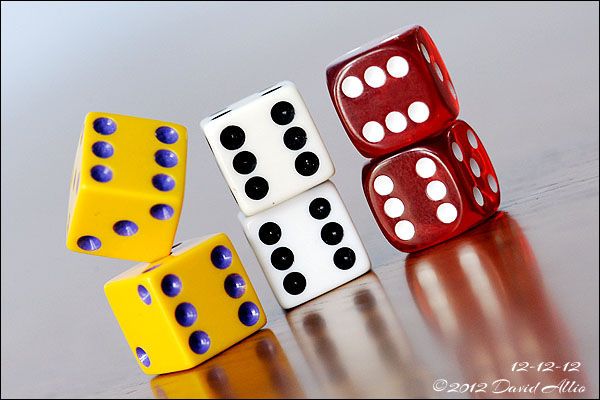
Aha! There is only one way to roll a 12 with a standard pair of cubes – two sixes. That parallels the uniqueness of today’s date. Add to that the fact that there is no accurate history regarding the origination of these gaming objects and I had finally found my subject – imperfect dice.
Now for a lesson in dice trivia: there is a difference between casino dice – perfect dice – and common or imperfect dice. Perfect dice have a sharp and precise cut with square edges. Imperfect dice have rounded edges and are commonly associated with board games for random number generation.
OK, so what are the odds of rolling a 12 with a pair of perfect or fair dice?
The calculation goes like this: the odds of rolling one six on a six-sided die are 1-in-6. Easy enough, so far. When a second die is added to the formula, the odds are not equal to the sum of six-plus-six. Instead, the odds are equal to multiplying six-time-six because there is only one way to make a 12 using two dice. So, the odds of rolling a 12 are 1-in-36. For the record, the odds of rolling a seven are 1-in-6 because there are six ways to make a seven with a pair of dice. Got that?
The odds of rolling six dice and getting all sixes as intended in this photograph for 12-12-12 are 1-in-46,656.
Now, how do you calculate the exposure for this tabletop micro photograph?




You must be logged in to post a comment.