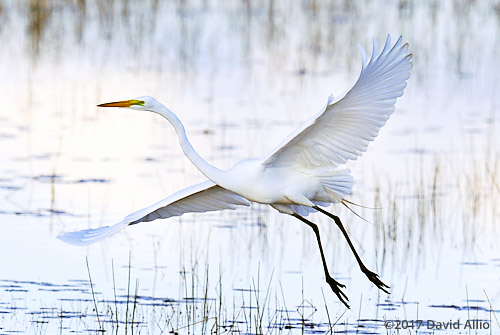
Great Egret – St Marks National Wildlife Refuge
A Great Egret Ardea alba glides above the water with Wings Outstretched near dusk in St Marks National Wildlife Refuge, Walkulla County, Florida. "Great Egrets fly slowly but powerfully: with just two wingbeats per second their cruising speed is around 25 miles an hour."1
1 Great Egret. Identification, All About Birds – Cornell Lab of Ornithology. Web. 09 Apr. 2017.
camera: Nikon D3 | lens: AF Nikkor VR 400mm f/2.8G IF-ED
focal length: 400mm | exposure: f/5 – 1/3200th second – ISO 500
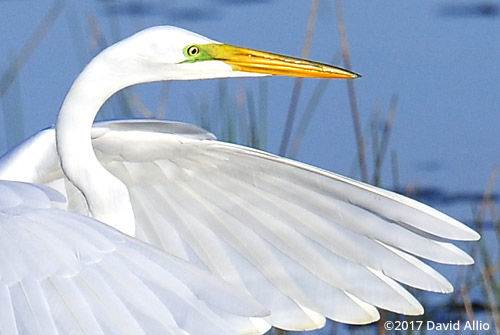
Great Egret – St Marks National Wildlife Refuge
"Great Egrets Ardea alba were hunted nearly to extinction for their plumes in the late nineteenth century, sparking conservation movements and some of the first laws to protect birds. The Great Egret is the symbol of the National Audubon Society, one of the oldest environmental organizations in North America. Audubon was founded to protect birds from being killed for their feathers."1
1 Great Egret. Identification, All About Birds – Cornell Lab of Ornithology. Web. 09 Apr. 2017.
camera: Nikon D3 | lens: AF Nikkor VR 400mm f/2.8G IF-ED
focal length: 400mm | exposure: f/5 – 1/4000th second – ISO 500
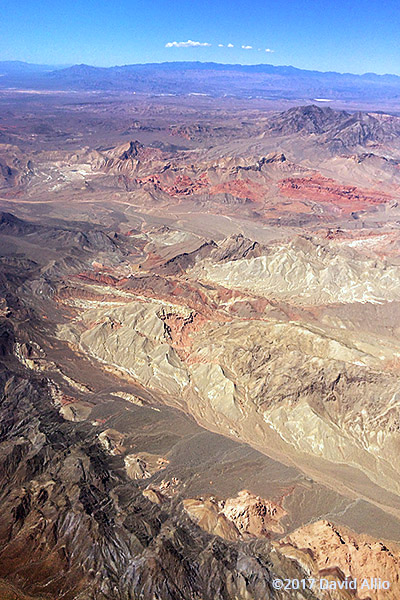
The Lake Mead 1:100,000-scale quadrangle includes some of the most spectacular scenery in the Basin and Range Province, scenery that is the direct result of the complex geologic history of the region. Extending from near the mouth of the Grand Canyon westward almost to Las Vegas, Nevada, the quadrangle exposes 1.8 billion years of geologic history through a tremendous range of strata, including Proterozoic crystalline rocks, Paleozoic and Mesozoic sedimentary rocks, Tertiary sedimentary, volcanic and plutonic rocks, and Late Tertiary to Quaternary surficial deposits. This history begins with the suturing of continents to form the Proterozoic crystalline basement, followed by deposition of Paleozoic strata along a continental margin. Mesozoic sedimentation, responsible for many of the brilliant colors seen in the Lake Mead area, began first on the craton side of an island arc and later in the foreland of Late Mesozoic (Sevier) thrusting.1
1 United States Geological Survey, Beard, L.E., et al. “Preliminary Geologic Map of the Lake Mead 30’ x 60’ Quadrangle, Clark County, Nevada, and Mohave County, Arizona.” USGS, 2007. .
iPhone 5s | lens: 4.2mm f/2.2
focal length: 4.2mm | exposure: f/2.2 – 1/2053 second – ISO 32


