The Eastern Purple Coneflower, Echinacea purpurea is a colorful member of the Asteraceae family of flowering plants. This particular bloom in the garden at the Mount Washington Bed and Breakfast in Shelburne, New Hampshire, attracted detailed attention from this passing bee.
Innkeeper Mary Ann Mayer expressed concern that the flowerbeds around her B & B were not in the best condition for photographs. But neither the flowers nor the bees seemed to mind.
A passing cloud provided a natural softbox for the lighting of this photograph created with a Nikon D3 camera fitted with a Nikkor Micro AF 60mm f/2.8D lens. The exposure data includes an aperture of f/11, a hand-held shutter speed of 1/200th of a second with a film speed of 800 ISO.
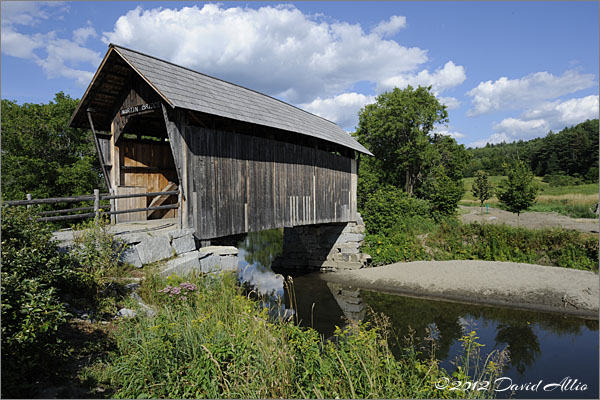
The Martin Covered Bridge near Plainfield, Vermont, is one of nearly 100 covered bridges in the state. As with this bridge, nearly half have undergone extensive renovations within the past decade. Most Vermont covered bridges have either qualified or are already listed on the National Register of Historic Places.
According to information posted at the bridge, the Martin Covered Bridge was originally built in 1890 for agricultural use by the William Martin family. The 44 foot-long queenpost structure was built to span the Winooski River by Herman Townsend. Also known as the Orton Farm Bridge, the Martin Bridge is the last covered bridge for farm use remaining in Vermont.
A Nikon D3 camera body was equipped with a Nikkor AF Zoom 14-24mm f/2.8G lens and set to the maximum focal length. The exposure was made in accordance with the sunny f/16 rule with a film ISO of 200, a shutter speed of 1/200th of a second and an aperture of f/16.
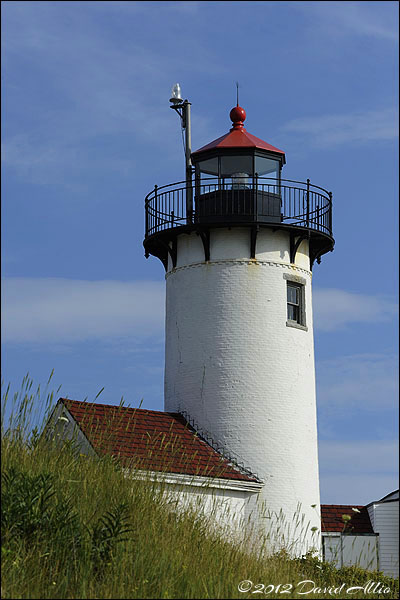
The coastline and major waterways of the United States are dotted with lighthouses in a variety of shapes, sizes, and colors. Eastern Point Lighthouse is a privately owned structure standing watch over the harbor entrance to Gloucester, Massachusetts. The original lighthouse built on this site in 1832 was replaced in 1890 with the structure still in service today.
For a photographer, correct exposure is the key to an image with proper definition and contrast– distinction between highlights and shadows – on the solid white painted masonry surface. Bright, direct sunlight may be the easiest way to obtain this definition, but what happens on those days of high hazy cirrus clouds?
Overexposure of the highlights leads to a loss of detail. The proper exposure for best definition of this white structure is to expose for the highlights.
The exposure formula for this photograph of the Eastern Point Lighthouse was an aperture of f/11, and a shutter speed of 1/400th of a second, with a film ISO of 200 – equivalent to the exposure for bright sunshine. A Nikon D3 camera and Nikkor AF VR Zoom 70-200mm f/2.8G IF-ED lens set to 155mm were hand-held for the composition.



You must be logged in to post a comment.