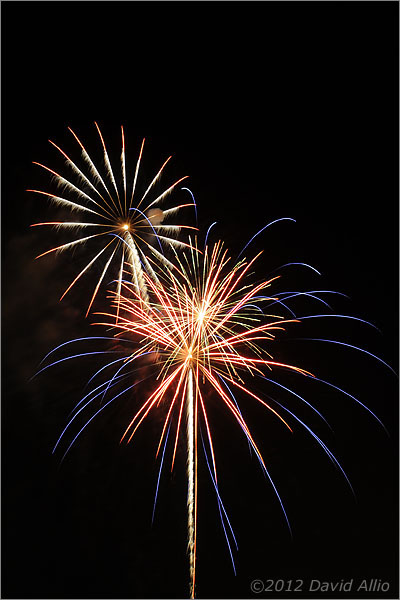
4th of July Fireworks | ©2012 David Allio
In most communities across the United States of America it is a heart-felt tradition to gather at a fairgrounds or public square near sunset on the 4th of July to “Ooh” and “Aah” at the “rocket’s red glare” and “bombs bursting in air.” Fireworks are one of the most discussed and popular photo opportunities of the summer.
Serious amateurs and professional photographers have benchmark settings for capturing the burning minerals streaking across the night sky. A starting point is essential. However, having photographed fireworks displays in nearly half of the United States, I have concluded that every show is different – varying in size, timing, content, and brilliance. Each of those factors impact proper exposure.
Although post-processing of digital images allows for sandwiching and layering of multiple single bursts into a frame filled with pyrotechnics, I remain a traditionalist and work to capture a well-composed image of multiple bursts in a single exposure. There is a greater feeling of accomplishment when all of the elements come together without time-consuming post-processing.
This photograph from a community fireworks show was merely re-sized from the high-resolution original before posting to the Web. A Nikon D3 camera equipped with a Nikkor AF Zoom 24-70mm f/2.8G lens was set to the minimum focal length. Based on the altitude and brilliance of the explosions an aperture of f/10 was selected. The pattern of this particular show was for two rockets to be launched nearly simultaneously. A shutter speed of 4 seconds allowed for two sets of shells to explode and spread during a single exposure. The exposure formula was completed with a film speed of 250 ISO. A tripod and remote trigger were used to prevent camera vibration during the exposure.
“Even if you’re on the right track, you’ll get run over if you just sit there.” – Will Rogers
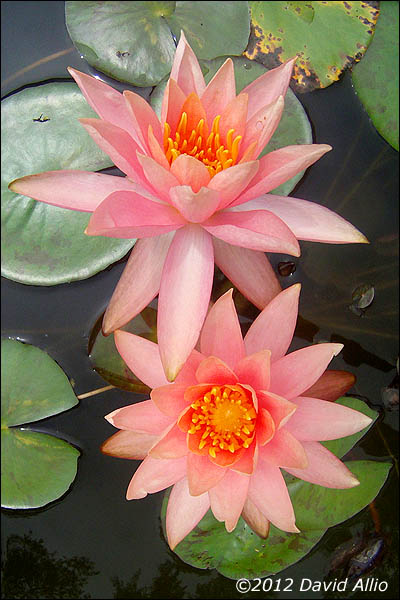
Water Lilies | ©2012 David Allio
A year ago I was poking fun at people that spent so much time on social media. Six months ago, I reluctantly started a blog. Now, I have three distinct blogs with links to facebook, twitter, tumblr, linkedin, google+, pinterest, and more.
“Even if you’re on the right track, you’ll get run over if you just sit there.” – Will Rogers
Recently, I was given the opportunity to play around with a small dedicated remote camera for the first time. These lightweight boxes are automated and do video as well as time lapse stills. This particular camera was not new. Image quality was not great – barely acceptable for web application even in reasonable daylight. But the most popular brand has evolved into a second version with significantly improved image quality and features, including a viewing screen and wireless to Internet.
This image was created by placing the camera on the end of a tripod and hovering over the water lilies at a range of about four inches. The automated settings for the camera with a built-in 5mm lens included an aperture of f/3.6 and a shutter speed of 1/1002th of a second, at a film speed of 100 ISO. Used in this way, the camera does provide for a unique perspective – an angle I probably would not attempt with an expensive DSLR.
At one time it was believed that a DSLR was the “right track” in the evolution of photography. Now, the “right track” may be an inexpensive remote camera. Or, in order to keep from being “run over” by instant posting on social media, a hi-rez camera phone for a few hundred dollars may be the “right track”.
Upon further consideration, maybe the “right track” is not the technology as much as it is to be a creative craftsman with the tools at hand. A lot of people were “run over” in the transition from film to digital imaging a decade past.
“Even if you’re on the right track, you’ll get run over if you just sit there.” – Will Rogers
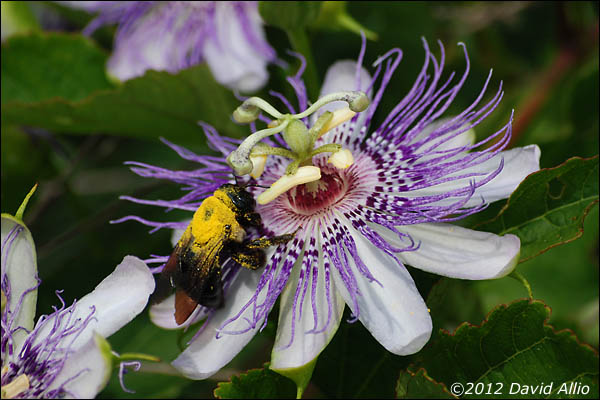
Passiflora incarnata | ©2012 David Allio
Common Eastern Bumble Bees Bombus impatiens and insects fight over the Purple Passionflower Passiflora incarnata. Through thoroughly unscientific observation the nectar must be intoxicating as bees seem to be attempting to fly drunk after a visit to the bloom.
This Purple Passionflower photograph was created using a Nikon D60 camera equipped with a Nikkor AF VR Zoom 55-200mm f/4-5.6G IF-ED set to the maximum focal length. The vibration reduction was on for this hand-held exposure. The aperture was f/8, shutter speed 1/1000th of a second, and film speed of 400 ISO.


You must be logged in to post a comment.