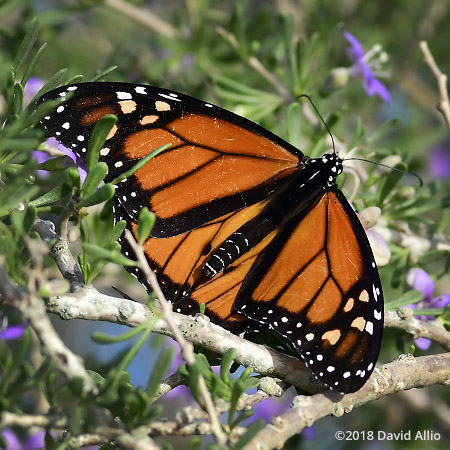
Monarch butterfly – Americana Collection
“The monarch Danaus plexippus is one of the most abundant and widely recognized butterflies in the world. Like most butterflies, monarchs are pollinators that play an important ecological role in maintaining biological diversity.”1
camera: Nikon D500 | lens: AF Nikkor VR 300mm f/2.8G IF-ED with Nikon AF-S Teleconverter TC14E III
focal length: 420mm | exposure: f/5.6 – 1/2500 – ISO 500
1Harvey, Rebecca G, et al. “Native Habitats for Monarch Butterflies in South Florida.” Native Habitats for Monarch Butterflies in South Florida, IFAS Extension University of Florida, June 2018, edis.ifas.ufl.edu/pdffiles/UW/UW31100.pdf.
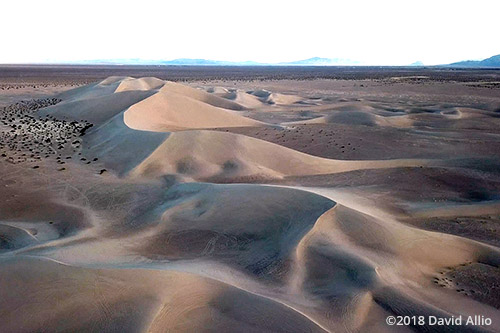
Big Dune – Americana Collection
Big Dune of Amargosa Valley, Nevada, is culturally important because it is one of a number of sand dunes in Numic territory that are considered singing sand dunes. The dunes emit low-frequency sounds that are caused when moisture is found within the sand particles, the temperatures are high, and some sort of impact occurs that cause the sands to shift. Wind, earthquakes, or human activity can create enough impact to cause the sand dunes to shift. The booming sound of the sand dune is emitted when avalanches occur on the leeward face of the dune and when the avalanches are at an angle that mirrors to the natural angle of sand deposition. Collisions between the grains of sand cause the grains to become synchronized. When this occurs, the outer level of sand vibrates. From a cultural perspective, the emission of tones and measurable musical notes are a testament that this land feature is alive and it can interact with all elements of the universe.
aerial platform: DJI Mavic Pro | camera: FC220 | lens: 4.7mm
focal length: 4.7mm | still frame from video
FAA UAS Part 107 Licensed
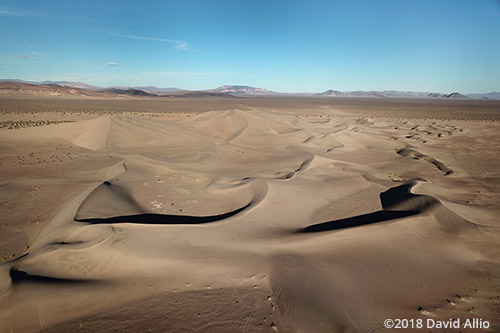
Big Dune – Americana Collection
Nevada’s Big Dune of Amargosa Valley is a star dune, produced when the dominant wind blows a steep side of the dune and results in an arm. As the wind shifts, more steep sides are created, and the arms of the dune rotate around the center, producing a star shape.
aerial platform: DJI Mavic Pro | camera: FC220 | lens: 4.7mm
focal length: 4.7mm | exposure: f/2.2 – 1/2146 – ISO 100
FAA UAS Part 107 Licensed


